
Knox County Criminal Court Cases
The Criminal Court for the Sixth Judicial District has three Knox County felony divisions. General Sessions Court hears misdemeanors, bond and citation matters, and the first steps in felony cases before a bind-over. A bind-over sends a charge onward after the lower court finds enough cause for further action. The Criminal Court Clerk keeps both Criminal Court and General Sessions-Criminal files, along with Fourth Circuit records. That makes the clerk the key custodian for a filed charge, hearing history, judgment, sentence, costs, and certified disposition.
Knoxville City Court is different. It hears city-code, traffic, parking, and other qualifying municipal violations. It cannot replace a Knox County criminal case search for a felony. Federal prosecutions are separate too. They appear in the U.S. District Court for the Eastern District of Tennessee and must be searched through PACER. Identifying the court first prevents a common error: a person may have a municipal citation, a county prosecution, or a federal docket, yet only one of those files will be held by the Knox County clerk.
The Tennessee Judiciary provides statewide rules, forms, opinions, and appellate resources that frame local court work.
That statewide layer supports, but does not replace, the Knox County clerk's local criminal docket and copy services.
Three Knox County Court Divisions
One clerk serves a court system with distinct roles. A felony may begin with a warrant, bond decision, or preliminary step in General Sessions, then move to one of the three Criminal Court divisions after indictment or another lawful charging route. Misdemeanors usually stay in General Sessions unless they travel with felony counts. The division and case number matter because a name alone can point to more than one person or more than one file.
The July 2025 clerk report shows the scale of this local record flow. It listed 68 indictments, 18 presentments, 63 informations, 326 General Sessions cases dispositioned, 1,873 felony cases, 1,146 misdemeanor cases, 999 DUI cases, and 2,504 bonded or cited cases. These are office workload categories, not a crime rate and not a count of convictions. They explain why a daily calendar is only a view of scheduled court work, not a complete Knox County criminal history.
Note: A division number and case number are stronger identifiers than a name when the Knox County docket contains several possible matches.
Searching Knox County Case Records
The Knox County Criminal Court Clerk provides the official Court Date Search and Daily Docket paths. A case number is best when known. For a name search, compare the court date, division, and charge context before treating a result as the correct person. The local court app supplies court dates, the daily docket, courthouse tools, and resources. KnoxCourtPay is a separate app for payments, record tracking, and reminders, so it should not be mistaken for the main case-search route.
- Open the clerk's Court Date Search or Daily Docket and choose the tool that fits a person search or a known court date.
- Use the case number when available. Otherwise, search the name and compare every available identifier.
- Confirm the division, date, charge context, and next setting before relying on the match.
- Read the docket events in order, since an intake charge may later be amended, dismissed, or replaced.
- Call or visit the clerk for an older case, archived file, plain copy, or certified disposition not supplied by the online view.
The research found the following fields and controls in the clerk's access path. Exact live prompts can change, and the public materials do not state that every field appears in one form.
| Search Item | Format | Best Use | Limit |
|---|---|---|---|
| Case number | Clerk-assigned identifier | Direct match | Must be known |
| Party name | Name query | Starting without a number | Common names need context |
| Court date | Date or calendar view | Finding a scheduled appearance | Not a full history |
| Division | Court division | Separating similar entries | May require docket review |
| Charge context | Docket description | Confirming a likely match | Charges can change |
Missing Knox County Case History
A daily docket is built for current settings. It may not surface the historical file a reader needs. When a Knox County criminal court case is absent, call the clerk at 865-215-2375 and give the name, approximate filing period, known division, and case number if available. The same office can explain archived access and estimate the cost of a large copy request. Do not infer a per-page fee from the clerk's workload report, since the research did not verify the current schedule.
In-person inspection and copy requests go to Suite 149 in the City-County Building, 400 Main Street SW, Knoxville, TN 37902. Published counter hours are weekdays from 8:00 a.m. to 4:30 p.m. Ask for a certified disposition when the final outcome must be proved. A screenshot of a calendar entry is weaker because it may omit the judgment, later docket activity, or the clerk's certification. PACER needs its own search if the charge was federal rather than state or county.
Criminal Court Clerk
400 Main Street SW, Suite 149
Knoxville, TN 37902
865-215-2375
Weekdays, 8:00 a.m.-4:30 p.m.
Inside a Knox County Case File
A Knox County court file follows the prosecution, not just the arrest. Its header can show the case number, court division, filing date, status, judge, and next setting. Party fields identify the State of Tennessee, the defendant display name, and counsel of record. Charge rows may give a description, statute or class when entered, count number, and charging instrument. The docket then records hearings, motions, pleas, judgments, and later process such as a capias or appeal.
| Case Number & Court | The clerk identifier, court level, division, filing date, status, judge, and next setting. |
|---|---|
| Charging Document | A complaint, indictment, presentment, or information and its filed counts. |
| Docket Entries | Filed events, motions, orders, hearings, pleas, trial activity, and later process. |
| Hearing Dates | Past and future settings as entered by the clerk, subject to change by court order. |
| Disposition & Judgment | The outcome of each charge, such as dismissal, plea, acquittal, or conviction. |
| Sentence & Conditions | Confinement, probation, fines, costs, restitution, and other terms when public. |
Bond and current custody require care. The court file can preserve a bond amount and type, but the Knox County Sheriff's Office is the source for present jail status. Protected identifiers, victim or minor details, and sealed or expunged material may be redacted or withheld.
Knox County Diversion Case Path
Judicial diversion can make a Knox County docket look hard to read. A qualified person enters a plea and follows probation terms, but the court withholds a final judgment of guilt. Successful completion can lead to dismissal, followed by a separate expungement filing. A violation can result in conviction and sentencing. This is why the plea entry cannot be read alone. The final judgment and any later expungement order control what happened. The Knox County District Attorney's judicial-diversion explanation describes eligibility, conditions, the $100 TBI application fee, and consequences.
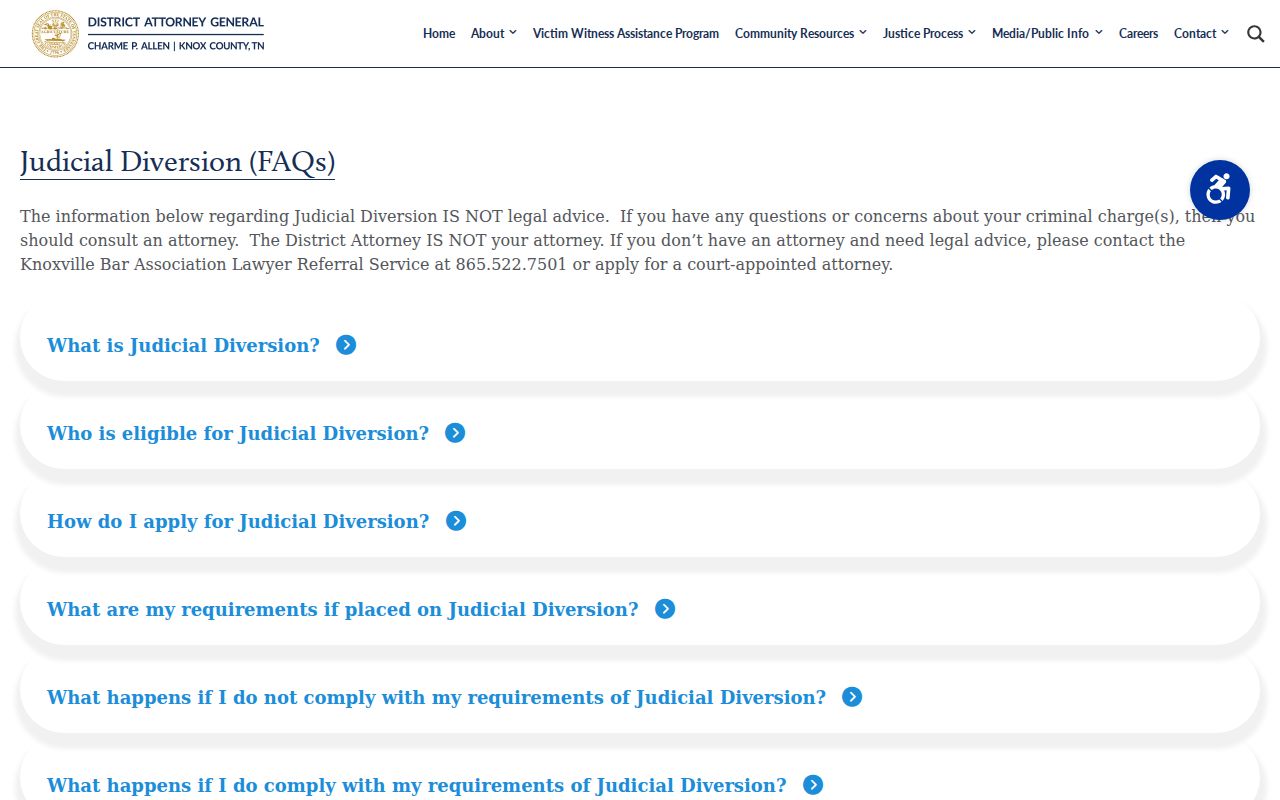
The source image places dismissal and expungement after compliance, which helps readers follow later docket entries in the right order. The clerk and District Attorney also coordinate local expungement screening. The current DA material says sessions occur on the third Thursday of each month, while a clerk page has shown a weekly Thursday schedule. Call before travel. Successful diversion does not erase its own public trail; the expungement order must still be filed and sent to the relevant agencies. The clerk's expungement screening page supplies the current local contact path.
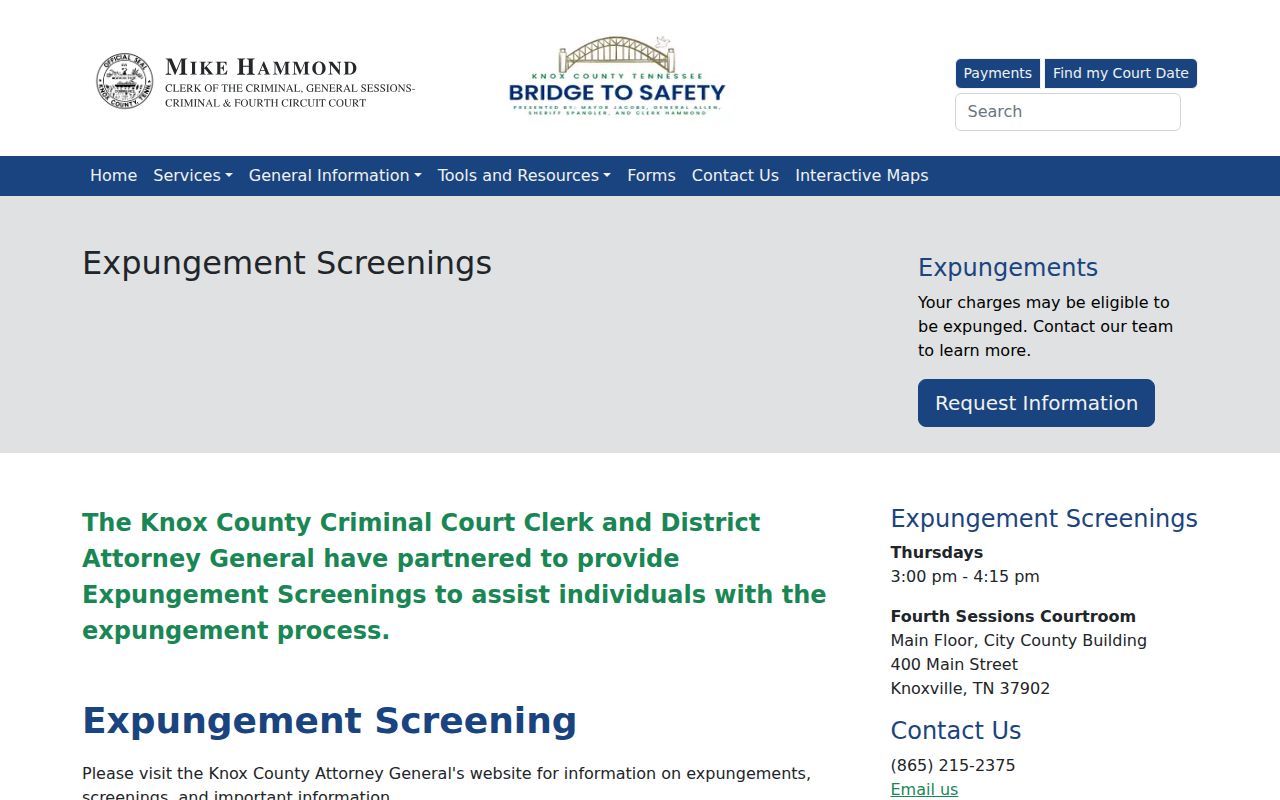
That clerk resource connects the case file to the screening and order process required for eligible Knox County records.
How a Criminal Case Moves
A reportable Knox County case may begin with an arrest, citation, or complaint. General Sessions handles early felony steps and many misdemeanor cases. A felony can then move through a grand-jury indictment, presentment, or another authorized charge into Criminal Court. Arraignment is the hearing where charges are stated and a plea is entered. Pretrial work may include motions, evidence issues, plea talks, and repeated settings. The matter ends through dismissal, plea, trial verdict, or another lawful disposition, followed by sentencing when there is a conviction.
Case flow: Charges Filed › Arraignment › Pretrial › Plea or Trial › Disposition › Sentencing
Each stage leaves a different docket mark. An indictment is a formal accusation, not proof of guilt. A disposition is the recorded outcome of a charge. A nolle prosequi means the prosecutor formally chose not to proceed with that charge at that time. Read all counts because one can be dismissed while another ends in a plea or verdict.
Knox County Mental Health Court
Knox County's Mental Health Court received Tennessee certification after a December 2024 site visit. It is a voluntary, five-phase program for eligible people whose nonviolent charges are linked to mental illness. Treatment, testing, and recurring court review form part of the record. Depending on the case, completion may support dismissal, an alternative to jail or prison, or a change from a felony to a misdemeanor. Those outcomes make the final order more useful than an early charge screen.
The clerk's Mental Health Court certification announcement documents the local milestone.
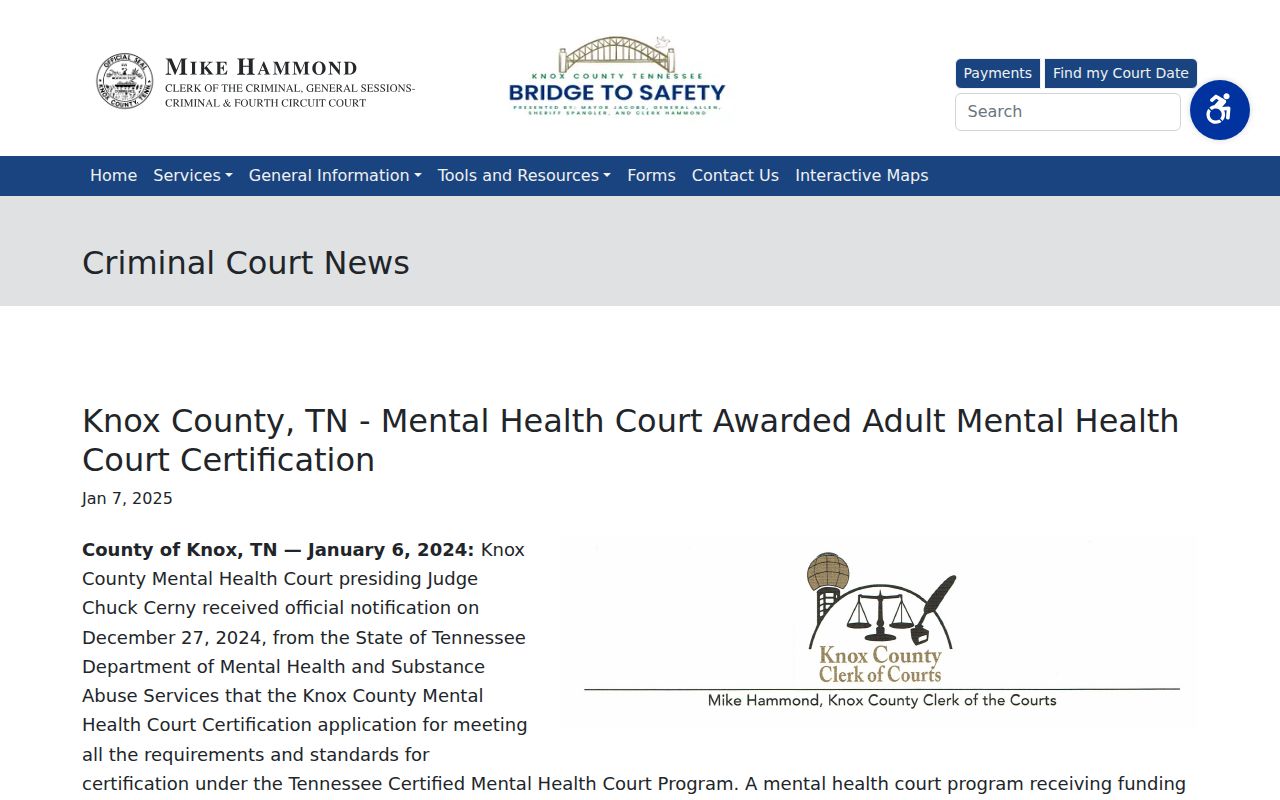
The announcement gives case readers context for repeated reviews and program phases that may appear before the final Knox County disposition.
Reading Knox County Case Outcomes
Short terms can carry the key result in a Knox County criminal case. Read them beside the count number and date. A dismissal ends a charge without conviction. An acquittal is a not-guilty finding. A conviction is a judgment of guilt after plea or verdict. A capias commands arrest, often after a missed appearance or failure to comply, but it is not a disposition of the underlying count.
- Indictment
- A grand jury's formal felony accusation. It does not decide guilt.
- Presentment
- A charging instrument that begins through the grand jury's authority.
- Information
- A prosecutor-filed charging instrument used when Tennessee law permits it.
- Nolle prosequi
- The prosecutor's formal choice not to proceed with a charge at that time.
- Disposition
- The clerk-recorded outcome for a charge or case.
Note: Compare the docket's last event with the signed judgment because a setting, bond entry, or plea does not alone prove the final outcome.
Case Record Access & Restrictions
The Tennessee Public Records Act generally supports inspection of public records by Tennessee citizens, while Tennessee Supreme Court Rule 34 and confidentiality laws shape access to court material. Public does not mean unredacted. Social Security numbers, protected victim details, information about minors, and other confidential identifiers can be removed. Juvenile cases, sealed matters, and expunged records fall outside ordinary public access. Grand-jury deliberations are secret even when an unsealed indictment later becomes part of a public case.
The official text of Tennessee Supreme Court Rule 34 addresses media and recording practices.
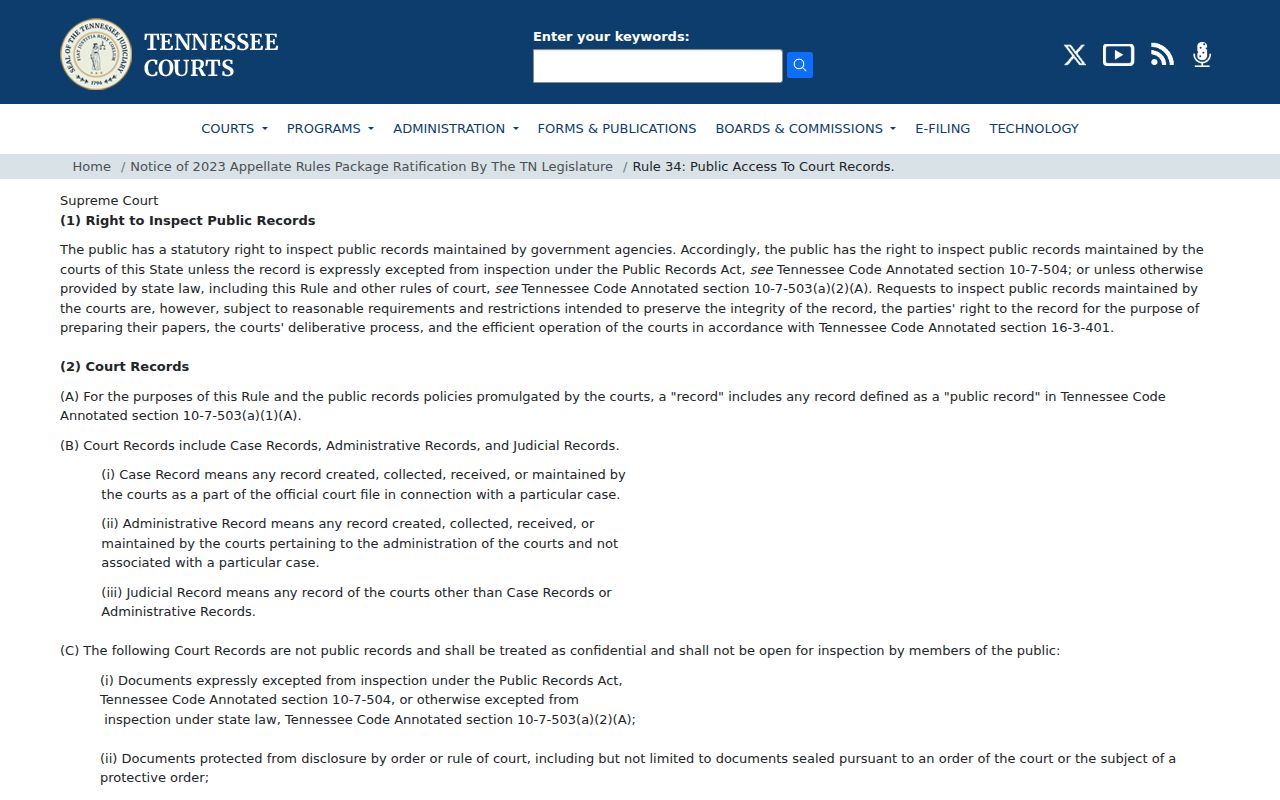
The rule source also shows why access to a filed record and permission to record a proceeding are separate questions.
If an online Knox County case result is missing, ask the clerk whether the record is archived, restricted, or under a court order. A Tennessee public-records request cannot reopen an expunged file. The case record remains the best place to confirm charges, rulings, and outcome; the earlier custody event belongs in the Knox County arrest lookup.